The fortune and misfortune of a patient rest with the physician, and the physician's responsibility is heavy. However, the authority does not lie with the physician but with those who employ the physician. Why is this so? When a person suffers from a severe illness, and an incompetent physician is at a loss, they then seek help from a renowned physician. The renowned physician enters the room, examines the patient, and explains where the illness originated and how it should be treated; why certain types of medicine exacerbate the condition, why certain types of medicine alleviate one aspect of the illness but fail to address others completely; why the condition seems to improve slightly but relapses after one or two days, or even worsens compared to before. The physician explains each point clearly to the patient's family, determining how to correct errors, how to apply warming, cooling, attacking, or tonifying methods, and how to prescribe according to the method. They predict what symptoms will appear after taking the medicine and what symptoms will indicate recovery, forecasting the exact day and time of recovery. If the patient's family can trust every word without doubt, and if their bookshelves do not contain works like "Bencao Beiyao," "Yifang Jijie," "Wanbing Huichun," "Bencao Gangmu," "Dongyi Baojian," "Fengshi Jinnang," "Chishui Xuanzhu," "Xueshi Yian," "Jingyue Quanshu," "Shishi Milu," "Bianzheng Qiwen," "Linzheng Zhinan," and if there are no relatives or friends who pretend to know what they do not, or physicians who are ambiguous and known for prescribing mild, ineffective medicines, then the renowned physician can fully utilize their expertise. Febrile diseases and sudden illnesses can be cured within two or three days, with the longest not exceeding eighteen days; wind disorders, consumptive diseases, abdominal distension, and diaphragm obstructions can be cured within a month, with the longest not exceeding three months. Otherwise, if the patient's family is half-doubting and half-trusting, an ordinary physician might still manage to treat the illness, waiting for the disease to weaken and heal on its own. However, a physician who claims to be renowned must not shoulder such a heavy responsibility, as it may lead to resentment and damage their reputation. I have experienced this bitterness due to my passionate nature, and I hope all my colleagues can learn from this lesson. Nowadays, some practitioners rely on eloquence, associating with those who agree with them and mutually praising each other, while not rejecting those who defer to them, pretending to be profound. As for those who delve into the "Shennong Bencao Jing," study the "Lingshu" and "Suwen," and follow Zhang Zhongjing's methods, their theories are unheard of, and their treatment results are rarely seen. They modestly say, "I cannot achieve such divine results, nor can I use such extreme methods to succeed." These people create the term "extreme," allowing the method to be elevated by one zhang while the demon rises by ten zhang. They claim that ancient books cannot be applied today, labeling those who read extensively as extreme. They revive seemingly hopeless cases and are viewed as extreme for their unconventional and risky approaches. As a result, the patient's family is influenced by preconceived notions, gathering many physicians who are not extreme, trying them one after another without success. Only as a last resort do they turn to a desperate measure, yet they still suspect it is extreme. When using ephedra, cinnamon, mirabilite, or rhubarb, they say the sweating or purging is too excessive; when using ginger, aconite, scutellaria, or coptis, they say the cold or heat is too intense; when using Jianzhong, Lizhong, Xianxiong, or Shizao formulas, they say the tonifying or purging leaves no room for adjustment. For nourishing yin with rehmannia or tonifying vitality with ginseng, they are used less when they should be used more; for common jujubes or inexpensive licorice, they are used more when they should be used less. Such seemingly reasonable but actually erroneous statements are even worse than reckless and irrational remarks. Those who understand the situation may choose to leave, yet they still say the illness can be treated and cannot bear to abandon it heartlessly. Although this reflects a relentless desire to save lives, doubtful matters yield no success, failing to save lives and even harming them. Medicine circulates through the meridians, organs, and tissues, reaching both internal and external parts, driven by qi. Qi does not move on its own; it is governed by heart qi and strengthened by gallbladder qi. If the patient doubts my methods as extreme, and upon seeing my prescriptions, which are beyond their expectations, their heart qi becomes disordered. The "Neijing" states: "The heart is the official of the monarch, from which spirit and intelligence emanate." It also says: "If the monarch is not clear, the twelve officials are endangered." Not only does heart qi become disordered, but gallbladder qi also becomes timid as a result. The "Neijing" states: "The gallbladder is the official of justice, from which decisions are made." It also says: "The twelve meridians all depend on the gallbladder." Medicine consists of grass roots, tree bark, and all kinds of inert minerals, relying on the body's true qi to circulate. Now, with heart qi disordered and moving recklessly, and gallbladder qi timid and stagnant, when scutellaria or coptis is taken, their cold nature follows the patient's thoughts, causing chills and cold symptoms; when ginger or aconite is taken, their heat nature follows the patient's thoughts, causing restlessness and flushed face, leading to heat symptoms. These examples only scratch the surface, and there is no need to elaborate further. The reason behind all this is fate, and I simply follow nature. Why bother with unnecessary complications? I hope all my colleagues can learn from my experience as a cautionary tale, so that the Dao becomes more evident, and more lives are saved.
Chen Xiuyuan
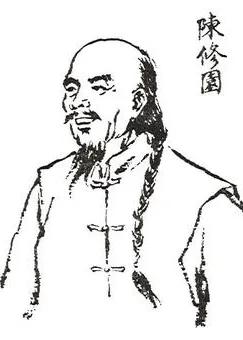
Qing Dynasty physician Chen Nianzu (1766-1833). His given name was Nianzu, courtesy names Xiuyuan and Liangyou, and literary name Shenxiu. He was a native of Changle, Fujian. In his youth, his family was poor, and he pursued the imperial examination while also studying medicine. He once studied medicine under the renowned physician Cai Zongyu (Mingzhuang) of Quanzhou, gaining considerable insights. He once cured a hemiplegic patient in the capital, earning widespread acclaim in Beijing, and later served as an imperial physician, treating illnesses within the palace. After returning to his hometown, he lectured at the Jingshan Caotang on Songshan Mountain. Throughout his life, he authored numerous works, with his medical thoughts rooted in the "Inner Canon," "Treatise on Cold Damage," and "Synopsis of the Golden Chamber." He wrote "Jinkui Yaolue Qianzhu," "Jinkui Fangge Kuo," "Shanghanlun Qianzhu," "Shanghan Yijue Chuanjie," and "Shennong Bencao Jing Du." Regarding Zhang Zhongjing's scholarship, he opposed the theory of textual errors. His approach to scholarship was rigorous, striving to "explain profound concepts in simple terms" and "progress from simplicity to complexity," dedicating himself to popularizing medicine. He authored works such as "Yixue Sanzi Jing" and "Yixue Shizai Yi," which served as introductory texts for beginners and were widely circulated. His other works include "Lingsu Jieyao Qianzhu," "Nüke Yaozhi," "Shennong Bencao Jing Du," "Shifang Ge Kuo," and "Shiyao Shenshu Zhujie." Later generations compiled his medical books into the "Nanyatang Yishu Quanji," also known as the "Chen Xiuyuan Yishu Shiliu Zhong." There are also editions such as "Chen Xiuyuan Yishu" in 21, 60, and 72 volumes. He held deep reverence for classical texts and ancient traditions, and he fiercely criticized renowned physicians such as Zhang Jingyue and Li Shizhen.