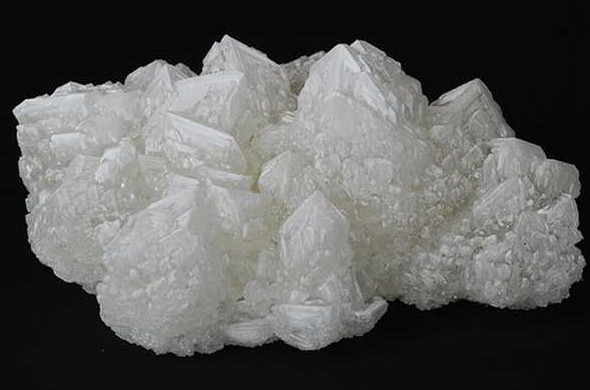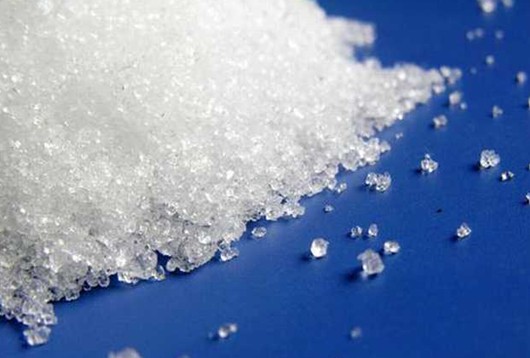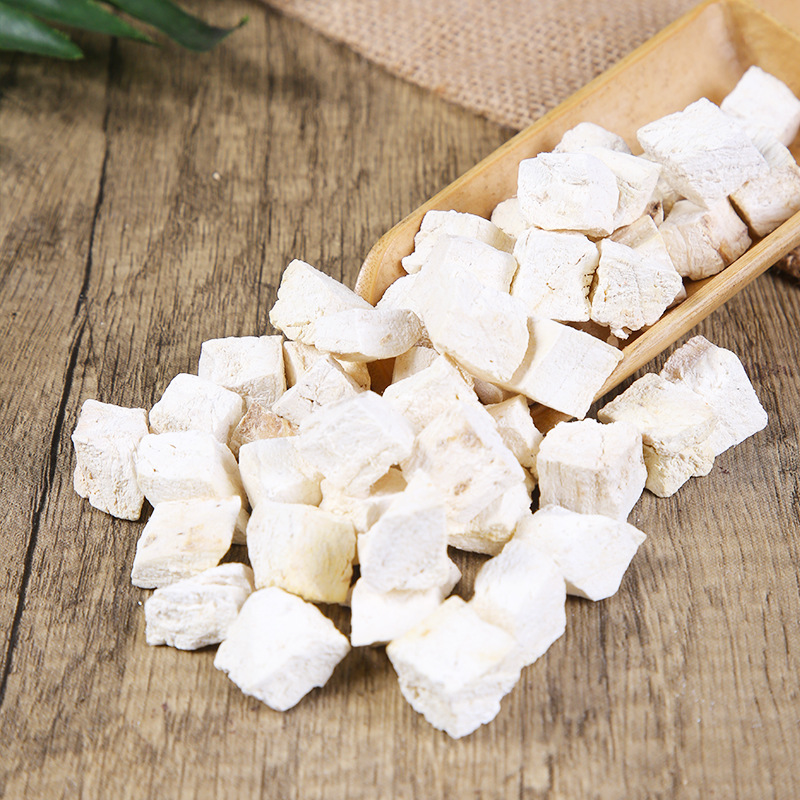
Mirabilite is the refined crystal obtained by boiling and refining the mineral mirabilite. The "Shen Nong's Herbal Classic" refers to it as saltpeter, also known as mirabilite. Some physicians believe that the crude saltpeter mentioned in the "Shen Nong's Herbal Classic" becomes mirabilite after processing and is not the same substance as saltpeter.
There are many types of nitre, and their names vary depending on the processing method. Generally, the naturally occurring substance, which is dissolved in hot water, filtered, and then crystallized upon cooling, is commonly referred to as crude nitre. Crude nitre is not used for medicinal purposes or is only applied externally. Because it can be used in tanning leather, it is also called leather nitre. When crude nitre is refined, sharp-edged crystals precipitate, resulting in Glauber's salt. Glauber's salt is purer in quality and can be taken orally for medicinal purposes. If Glauber's salt (composed of hydrated sodium sulfate) loses its water of crystallization through weathering and becomes powdery, it is called weathered nitre, also known as Xuanming powder or Yuanming powder.
In some pharmacies, when preparing formulas, Glauber's salt and Xuanming powder are not distinguished and are collectively referred to as Glauber's salt. Glauber's salt can also be called water saltpeter, which is in contrast to fire saltpeter (potassium nitrate).
I. Efficacy and Application
Mirabilite tastes salty and slightly bitter, and is cold in nature. It belongs to the stomach and large intestine meridians.
Efficacy It can purge and promote bowel movement, moisten dryness and soften hardness, clear fire and reduce swelling. Its characteristics include the ability of salty taste to soften hardness, bitter taste to promote downward discharge, and cold nature to eliminate heat. It is particularly effective in clearing heat and promoting bowel movement, making it a key herb for clearing pathogenic heat from the six fu organs and cleansing accumulated waste from the intestines. Zhang Xichun referred to it as a key herb for treating those with intense heart fire and excess heat.
It is commonly used for the treatment of conditions such as internal excess heat accumulation in the Yangming meridian, dry and hard stools, chest and abdominal fullness and hardness, abdominal masses and accumulations, and sores and ulcers. For external use, it can treat breast abscesses, hemorrhoid swelling and pain, and can also suppress lactation.
Summary of Masterpieces by Renowned Authors:
The Classic of Materia Medica: "It dispels pathogenic cold and heat, expels accumulations in the six bowels, resolves solid accumulations and lingering obstructions, and can dissolve seventy-two types of stones."
The Pearl Bag: "There are three uses of Glauber's salt: first, to dispel excess heat; second, to cleanse accumulated waste in the intestines; third, to break up hard accumulations and heat masses."
"Medicinal Properties": "Its salty taste softens hardness, thus it can remove dryness and stagnation; its cold nature descends downward, thus it can eliminate fire and dryness. It is indicated for seasonal epidemic heat mania, pathogenic heat in the six fu organs, or heat in the upper jiao diaphragm, or constipation in the lower body."
Changsha Medicine Explanation: "Mirabilite is bitter and extremely cold, it clears the lower blood aspect, purges fire to rescue from burning, softens hardness and breaks accumulations, benefits the water passages and unblocks strangury and obstruction, benefits the grain passages and opens knotty blockages, for knotty heat and steaming stagnation, nothing else can reduce it, for old phlegm and aged blood, nothing else can disperse it, its cold purging power is unmatched by other medicines."
Ben Cao Bei Yao: "Poxiao is sour, astringent, and acts swiftly, while Mangxiao, after processing, is slightly milder. It can cleanse the Sanjiao and gastrointestinal tract of excess heat, eliminating the old and bringing forth the new."
"Medical Records of Integrating Chinese and Western Medicine": "Treats heart heat generating phlegm, mental confusion, five-center tidal fever, restlessness and insomnia. Can relieve dry stool and constipation, and resolve all types of stagnation."
The renowned traditional Chinese medicine practitioner Mr. Wu Peiheng once proposed the concept of the "Ten Commanders" in Chinese medicine, specifically including: aconite, dried ginger, cinnamon bark, ephedra, cassia twig, gypsum, asarum, rhubarb, mirabilite, and coptis. These ten herbs are all key medicines in traditional Chinese medicine for attacking diseases and eliminating pathogens, and should be studied with emphasis.
II. Compatibility and Application
1. For excess heat accumulation and constipation with dry stools. Mirabilite can purge heat and promote bowel movements, moisten dryness and soften hardness. It is often used in combination with rhubarb to enhance the effect of purging heat accumulation.
For the syndrome of excess in the Yangming fu organ, characterized by constipation, abdominal fullness and distension, abdominal pain that worsens with pressure and feels hard upon palpation, or tidal fever and delirium, sweating on the hands and feet, or the syndrome of heat accumulation with watery diarrhea of clear, pure green color and foul odor, pain around the navel and abdomen that feels hard and lumpy upon palpation, or heat syncope, convulsions, mania, and other syndromes of excess heat in the interior, it is often combined with rhubarb, immature bitter orange, and magnolia bark to achieve the effects of clearing heat, promoting bowel movements, and urgently purging to preserve yin, as seen in the Major Purgative Decoction.
In the treatment of combined disease of Shaoyang and Yangming, presenting with alternating chills and fever, fullness and discomfort in the chest and hypochondrium, persistent vomiting, mild restlessness and depression, hard fullness in the epigastrium, or fullness and pain in the epigastrium, constipation, or diarrhea with fever, yellow tongue coating, and wiry, rapid, and forceful pulse, it is often combined with Bupleurum, Scutellaria, Rhubarb, Immature Bitter Orange, and Pinellia to jointly achieve the effects of harmonizing Shaoyang and purging internal heat accumulation, which is known as Major Bupleurum Decoction.
Zhang Xichun treated chronic constipation with difficulty in defecation and accompanying physical weakness by following the principle of Zhang Zhongjing's Chengqi Decoction. He used only one ingredient, mirabilite, boiled together with several jin of fresh radish in water to obtain a large bowl of concentrated decoction, which was taken in one dose. For patients with weak pulses who could not tolerate purgation, a small amount of ginseng, a few qian, could be added, stewed separately and taken together. This method was named Xiaoluo Tongjie Decoction. Using this approach to treat several cases of intestinal obstruction, remarkable effects were achieved each time.
The Inner Canon: "When heat is excessive within, treat with salty and cold, assisted with bitter."
Cheng Wuji said, "When heat is rampant within, it should be treated with salty and cold substances. For hardened qi, use salty substances to soften it; for excessive heat, use cold substances to dissipate it. Therefore, in Zhang Zhongjing's Great Decoction for Chest Bindings, Major Order the Qi Decoction, and Regulate the Stomach and Order the Qi Decoction, mirabilite is used to soften hardness and remove excess heat."
Xu Yuqing said, "Mirabilite dissipates and disperses, breaking up accumulations and softening hardness. Rhubarb purges and expels, moving without staying. Therefore, these two medicines complement each other, both serving as potent purgatives."
Modern research has found that after taking mirabilite, a hypertonic state is formed in the human stomach and small intestine, where the osmotic pressure is high. Water from outside the gastrointestinal tract will then permeate into the gastrointestinal tract, so after taking mirabilite, the water content in the intestines increases, making diarrhea more likely. Therefore, mirabilite has the effect of softening hardness and promoting bowel movements, making it suitable for treating dry and hard constipation.
2. For sore throat, mouth sores, red eyes, and sores. External use of Glauber's salt can clear heat. For treating swollen and painful throat, mouth sores, etc., it is often combined with Xuanming powder, borax, cinnabar, borneol, etc., known as Bingpeng powder.
For treating mastitis, external application of mirabilite can also be used to reduce lumps; it is also used for weaning.
Place mirabilite inside a watermelon, hang it in a sealed room to dissolve, then allow it to lose its crystalline water. Over time, a layer of frost will form on the outer skin of the watermelon, which is known as watermelon frost, effective for clearing the throat, reducing swelling, and relieving pain.
3. For mania due to exuberant heart fire. Mirabilite can purge heat from the heart channel and treat mania caused by exuberant heart fire. It can be used alone or in combination with other herbs.
Zhang Xichun said, "Mirabilite is the medicine that directly targets the heart meridian. It is most effective in reducing fire, resolving phlegm, clearing and benefiting the internal organs. It can eliminate strange syndromes when taken and cure mania and agitation when used."
III. Usage and Dosage
Mirabilite can be used in decoctions and is also suitable for making pills or powders. When used in decoctions, it should not be directly boiled; instead, it should be dissolved in the medicinal liquid or hot water and taken separately. The usual dosage ranges from a few grams to over ten grams. If used to relieve dryness and constipation in the Yangming meridian or to treat mania, the dosage can be increased, but it should be discontinued once the condition improves and should not be taken in excess or for a prolonged period. For pills and powders, use an appropriate amount; for external use, apply an appropriate amount.
IV. Application Precautions
Mirabilite is salty and cold, with a strong ability to soften hardness and promote bowel movements. Therefore, it is not suitable for those without substantial heat or dry and hard constipation. It is contraindicated for pregnant women.
Mirabilite is suitable for gastrointestinal dryness and constipation, but it should not be used in cases of acute abdominal conditions with excessive fluid accumulation in the intestinal cavity, as it may worsen the condition.
Wang Ang said, "If the disease is not deeply rooted in heat evil and obstructed, it should not be lightly administered, for fear of mistakenly harming the true yin of the lower jiao."
Zhang Xichun said, "Only those with chronic diarrhea should not take it."
Practical Notes on Traditional Chinese Medicine: Second Draft on the Evening of January 18, 2021