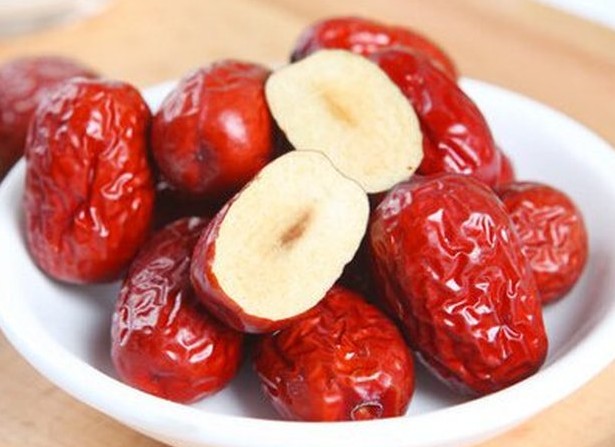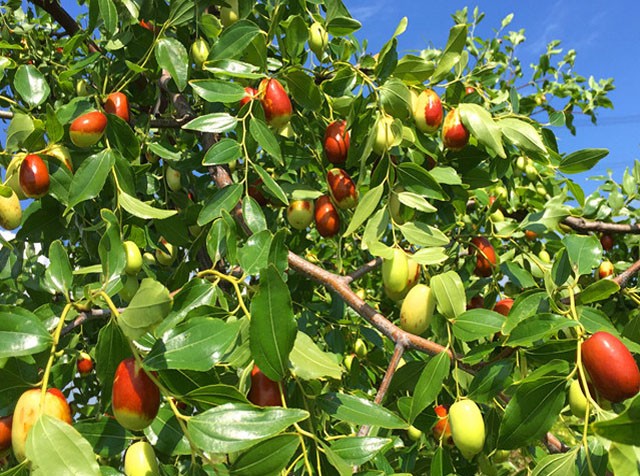
Jujube is also known as red date, with the larger ones being of better quality. It is produced all over the country, with those from the Xinjiang region being relatively superior. It is harvested when the fruit ripens in early autumn, then dried in the sun for use.
I. Efficacy and Application
Jujube tastes sweet and has a warm nature. It is a medicinal herb that acts on the spleen meridian and the blood aspect. It belongs to the spleen and stomach meridians.
Efficacy can tonify the middle and replenish qi, nourish blood and calm the spirit, moderate the properties of other herbs. Its characteristics are sweet and warm to tonify deficiency, rich in nutrients, truly an excellent product for nourishing the organs, qi, and blood of the human body.
Commonly used for the treatment of various deficiency syndromes such as spleen and stomach weakness, reduced appetite and loose stools, disharmony between nutrient and defense qi, insufficiency of qi, blood, and body fluids, palpitations and severe palpitations, as well as women's visceral agitation.
Summary of Famous Works by Renowned Authors:
"Ben Jing": "Calms the center and nourishes the spirit, assists the twelve meridians, replenishes deficiency of qi and body fluids, addresses deficiencies within the body, alleviates severe fright, heaviness in the limbs, and harmonizes all medicines."
Rihuazi Materia Medica: "Moistens the heart and lungs, stops coughing, tonifies the five viscera, treats deficiency and damage, and eliminates gastrointestinal stagnant qi."
Method and Image of Medicinal Use: Regulate the nutrient and defensive systems, promote the production of body fluids.
Changsha Materia Medica: "It replenishes the essence of the Taiyin Spleen Earth, transforms the Qi of the Yangming Stomach Earth, generates fluids to moisten the lungs and eliminate dryness, nourishes blood to enrich the liver and calm wind, treats spleen and stomach deficiency and damage, and regulates deficient and hollow meridians."
"Compendium of Materia Medica": "Tonifies the middle and augments qi, nourishes the spleen earth, moistens the heart and lungs, regulates the nutritive and defensive aspects, moderates yin blood, generates fluids, improves complexion, unblocks the nine orifices, assists the twelve meridians, and harmonizes all medicines. It is added in cases of cold damage and in tonifying formulas to promote the ascending qi of the spleen and stomach."
The Medical Records of Integrating Chinese and Western Medicine: "It is most capable of nourishing the blood vessels, moisturizing the muscles, strengthening the spleen and stomach, consolidating the intestines to stop diarrhea, harmonizing all medicines, and moderating the aggressive nature of potent drugs to prevent harm to the spleen and stomach. Although it is a common food, when used appropriately, it can achieve remarkable effects."
II. Compatibility and Application
1. For deficiency of middle qi, weakness of spleen and stomach, fatigue and weakness, reduced food intake and loose stools, etc. Jujube is sweet and warm, with the function of tonifying the middle and replenishing qi, and is also an excellent product that serves both as medicine and food. For treating various deficiencies and damages, and physical weakness, it is often combined in various tonifying prescriptions, such as Guizhi Decoction, Huangqi Jianzhong Decoction, Guipi Decoction, etc.
Among many prescriptions, jujube is most often paired with ginger. The two herbs complement each other, mitigating each other's shortcomings while enhancing their strengths. Additionally, they have the function of supporting the spleen and controlling potent herbs, making them a perfect match.
The Medicinal Properties of Drugs: The sweetness of jujube and the pungency of ginger, when combined, align with the classic saying that sweet and pungent flavors disperse and belong to yang. Therefore, they are essential in formulas for dispersing and relieving the exterior.
Zhou Bodu said, "Ginger has a pungent taste and yellow color, entering the defensive qi through the Yangming channel; jujube has a sweet taste and red color, entering the nutritive qi through the Taiyin channel. Its ability to enter the nutritive qi is due to the pungency within its sweetness. However, its capacity for sweet retention is strong, and with ginger, it avoids excessive retention; ginger's pungent dispersing power is strong, and with jujube, it avoids excessive dispersion. The combination of these two herbs makes them the primary agents for harmonizing the nutritive and defensive qi."
2. For blood deficiency with sallow complexion and women's visceral agitation. Jujube has the effect of nourishing blood and calming the mind. To treat women's visceral agitation and mental restlessness, it is often combined with licorice and wheat, known as the Licorice, Wheat, and Jujube Decoction.
If treating the syndrome of deficiency of both qi and blood in the heart and spleen, manifesting as palpitations, forgetfulness, insomnia, and sallow complexion; or the syndrome of spleen failing to control blood, manifesting as bloody stools, subcutaneous purpura, and metrorrhagia in women, it is often combined with ginseng, astragalus, angelica, longan aril, and sour jujube seed to collectively achieve the effects of replenishing qi and blood, strengthening the spleen, and nourishing the heart, as seen in the Guipi Decoction.
3. Used to moderate the properties of medicine. Jujube is sweet and warm, tonifying deficiency, and most embodies the virtue of earth, thus possessing the ability to control. It is often combined in potent prescriptions to moderate the properties of medicine and reduce toxicity, such as in Tingli Dazao Xiefei Decoction and Shizao Decoction.
Huang Yuanyu said, "Jujube is pure, harmonious, and dignified, possessing the full virtue of earth. Its flavor is sweet and fragrant, directly reaching the central palace and entering the spleen and stomach. Its sweetness benefits the stomach, and its fragrance benefits the spleen. Beyond its sweet fragrance, it contains the flavors of the four symbols: its pungency benefits the liver, its sourness benefits the lungs, its bitterness benefits the kidneys, and its saltiness benefits the heart. It nourishes the central palace and supports all its offspring, harmonizing both left and right, and extending in all directions without contradiction. Truly, it is a fine fruit of the world and a good medicine for humanity."
III. Usage and Dosage
Jujube is often used in decoctions and can also be made into pills. In decoctions, it is commonly used in quantities ranging from a few to over ten pieces, broken open for medicinal use. Different dosages yield different effects. For example, in the Ten Jujube Decoction, ten jujubes are used to control the potency of strong herbs.
IV. Application Precautions
Chinese dates can promote dampness and generate heat, so they are contraindicated in cases of excessive dampness with abdominal distension and fullness, food stagnation, parasitic infestation, toothache due to dental caries, as well as phlegm-heat cough.
Modern application, it is not suitable for individuals with "three high" constitution, alcohol-related diseases, diabetes, damp-heat and fullness, obesity, and nutritional excess.
Wang Ang said: Excessive consumption damages teeth, and it is contraindicated for those with abdominal fullness.
Practical Notes on Traditional Chinese Medicine: Second Draft of 21.1.24