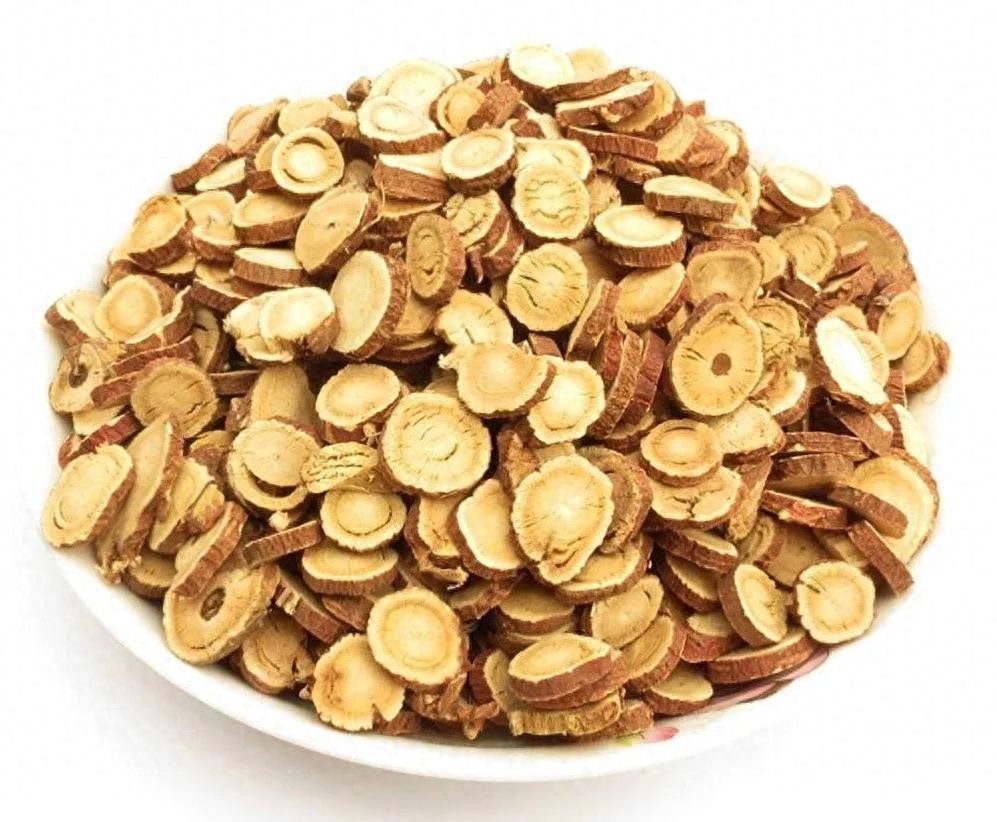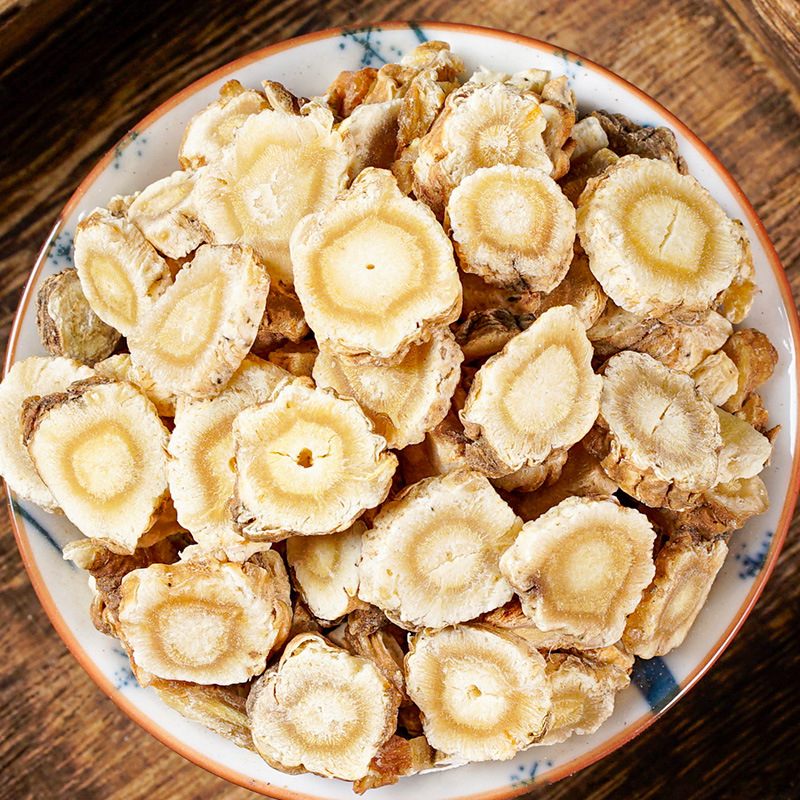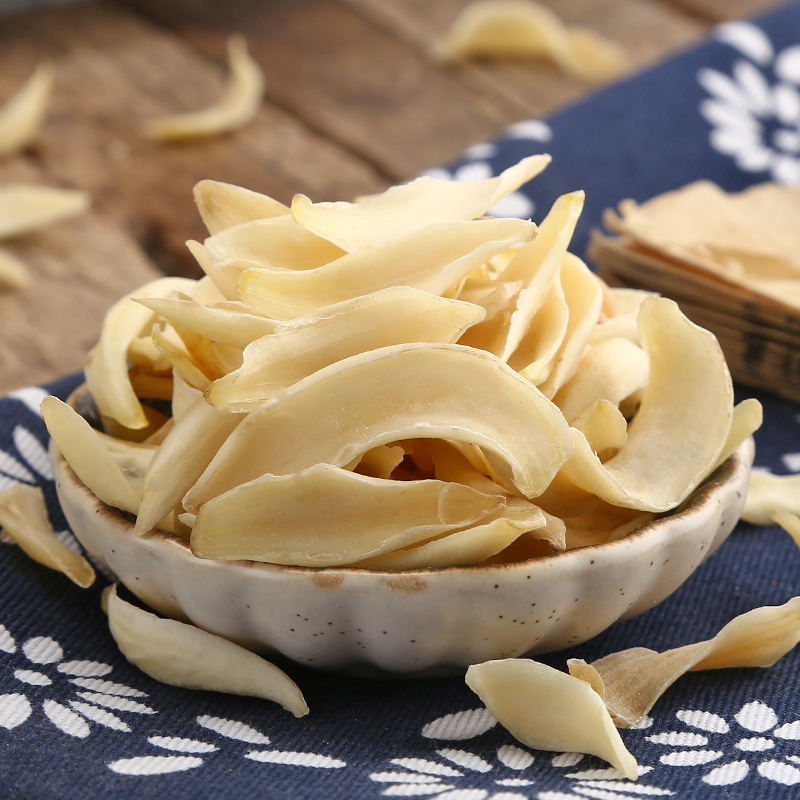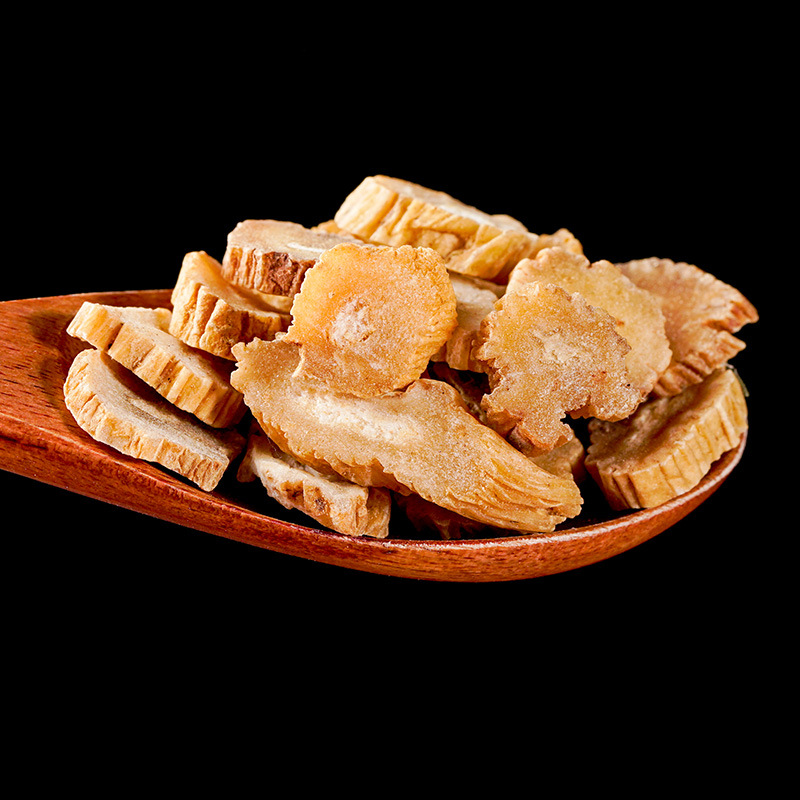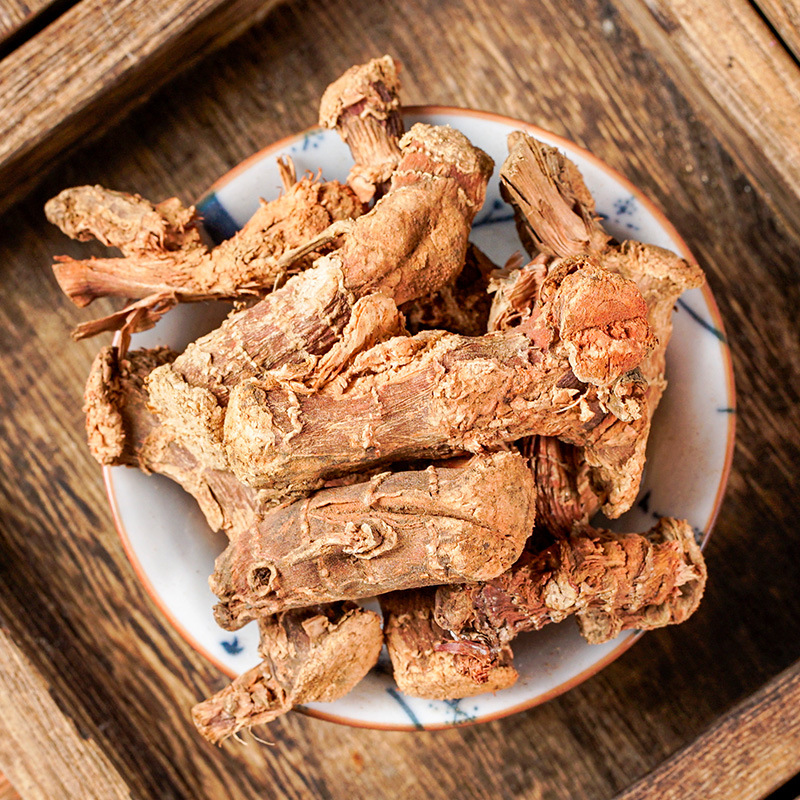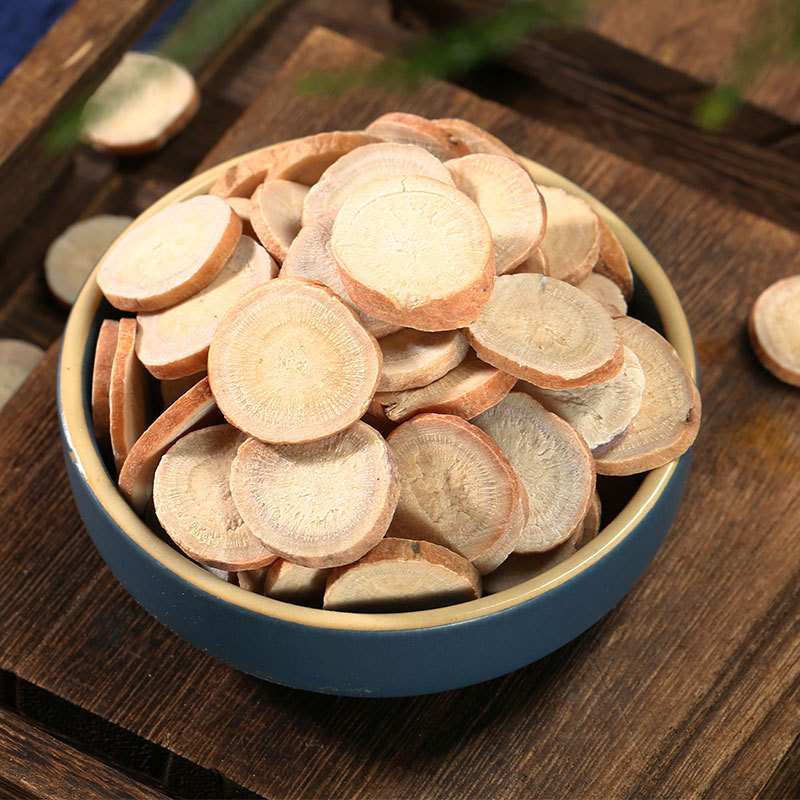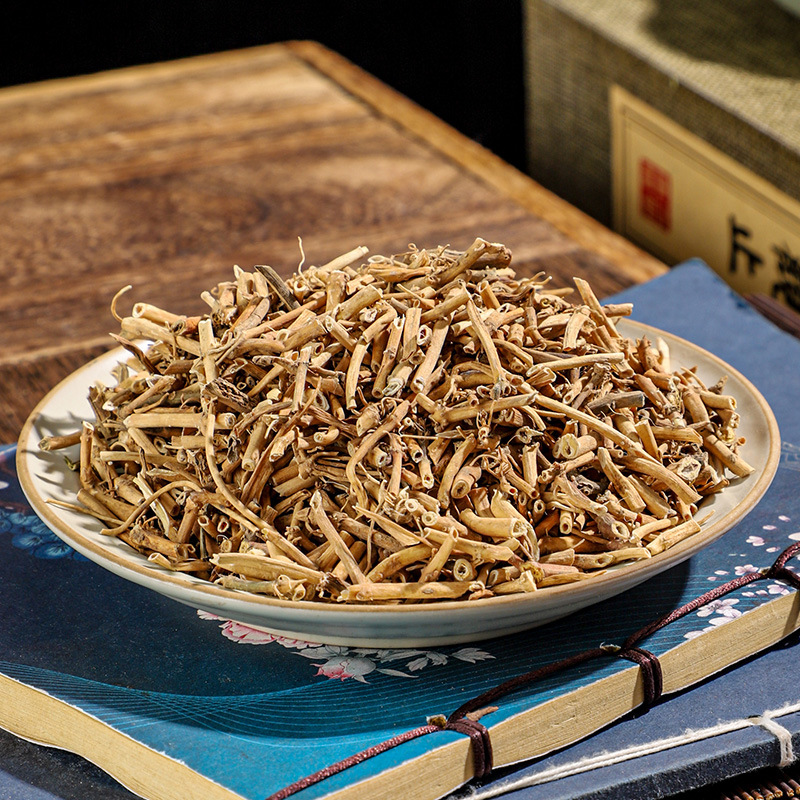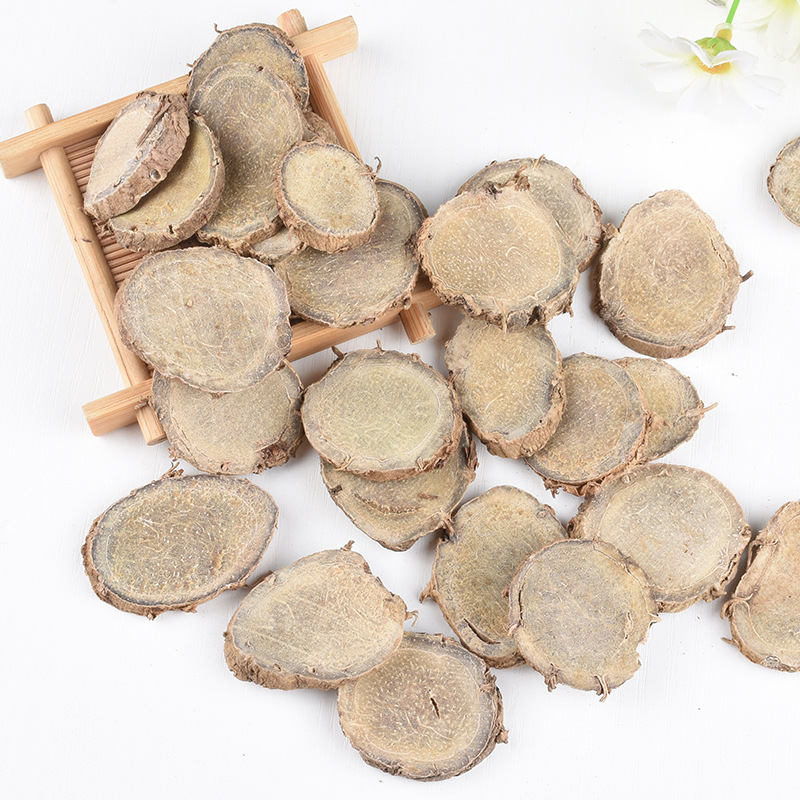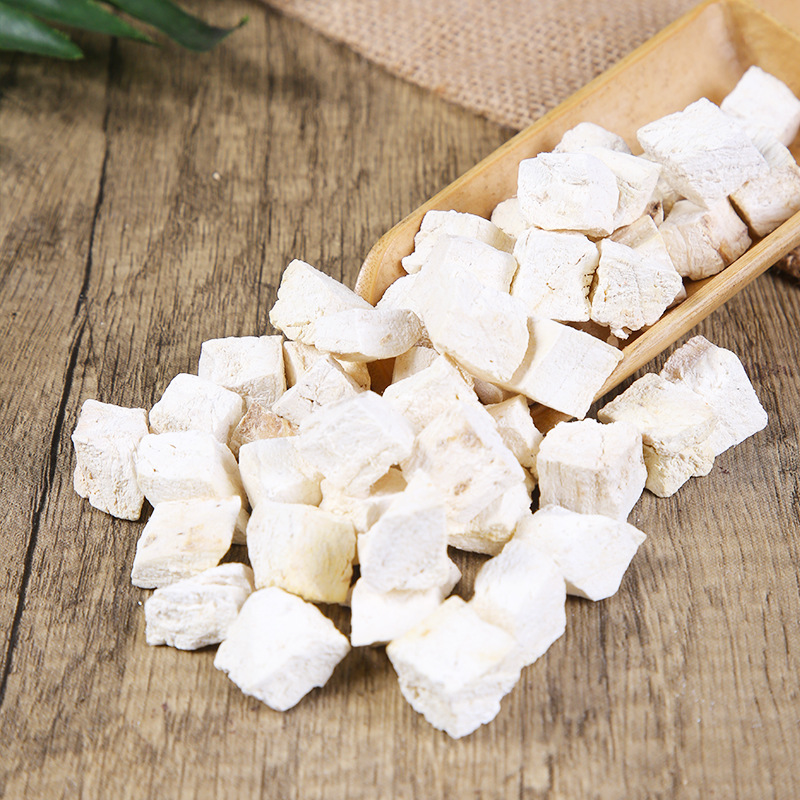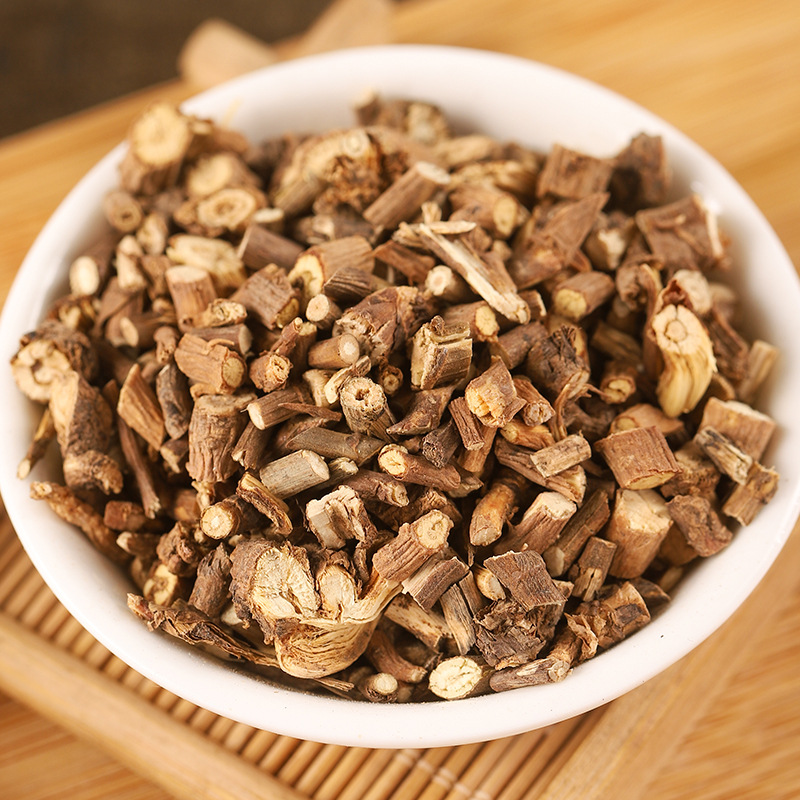
Licorice is the root and rhizome of the plant Glycyrrhiza uralensis from the legume family. It is named for its sweet taste. It is mainly produced in Inner Mongolia, Shanxi, Gansu, Xinjiang, and other regions. It is harvested in spring and autumn, sliced, and dried in the sun. It can be used raw or honey-fried.
I. Efficacy and Application
Licorice tastes sweet and is neutral in nature. It belongs to the heart, lung, spleen, and stomach meridians.
Efficacy It can tonify the spleen and replenish qi, moisten the lungs and relieve cough, alleviate acute pain, clear heat and detoxify, and moderate the properties of other herbs. Its characteristics include alleviating acute pain, detoxifying various toxins, and excelling at harmonizing other herbs. When combined with hot-natured herbs, it can moderate their heat; when combined with cold-natured herbs, it can moderate their coldness. It enables tonification without abruptness and purgation without haste. Due to its extremely high frequency of use and its ability to harmonize other herbs, it is honored as the "National Elder of Herbs" and is also regarded as the key herb among all medicinal substances.
It is commonly used for the treatment of spleen and stomach weakness, fatigue and weakness, palpitations and shortness of breath, cough with excessive phlegm, abdominal and limb spasmodic pain, abscesses and sores, as well as for alleviating the toxicity and potency of other drugs.
Modern pharmacology believes that licorice has a wide range of effects including anti-inflammatory, anti-allergic, anticonvulsant, anti-tumor, analgesic, and diuretic actions. It also exhibits hormone-like effects and can be used in the treatment of various "hormone-dependent" diseases. It is a traditional Chinese medicine worthy of in-depth modern research and exploration.
Summary of Famous Works by Renowned Authors
"The Classic of Materia Medica": "It governs cold and heat pathogenic factors in the five zang and six fu organs, strengthens tendons and bones, promotes muscle growth, doubles physical strength, treats metal-inflicted wounds and swelling, and detoxifies."
"Compendium of Materia Medica": "Relieves infantile fetal toxin and convulsions, reduces fire and alleviates pain."
"Pharmacological Classifications and Images": "When used raw, it greatly purges intense heat; when roasted, it warms and can tonify the qi of the upper, middle, and lower burners. It harmonizes with various herbs without conflict, has a gentle nature, and is adept at resolving various acute conditions, hence it is called the 'State Minister'."
Changsha Materia Medica: "It possesses the proper taste of harmony and the excellent quality of purity and richness. It enters the realms of both metal and wood, and resides between the two energies of water and fire. It nurtures the central region, fosters the four directions, and serves as a marvelous medicine for harmonizing the spirit and a miraculous elixir for regulating qi and blood."
Compendium of Materia Medica: "Sweet in flavor. When used raw, it has a neutral qi, tonifying spleen and stomach deficiencies and draining heart fire. When used roasted, it has a warm qi, tonifying the primordial qi of the triple burner and dispersing external cold. When added to harmonizing formulas, it tonifies and benefits; when added to diaphoretic formulas, it releases the muscles. When added to cooling formulas, it drains pathogenic heat; when added to potent formulas, it moderates the righteous qi; when added to moistening formulas, it nourishes yin and blood. It can harmonize various herbs, preventing them from conflicting. It promotes tissue regeneration and relieves pain, circulates through the twelve meridians, and detoxifies hundreds of medicinal substances, hence it is called the 'State Minister.'"
"Medical Records of Integrating Chinese and Western Medicine": "Licorice root is slightly warm in nature and extremely sweet in taste, embodying the essence of earth qi. All things are born from the earth and return to the earth to transform, thus it can neutralize all toxins. Sweetness governs harmony, hence it has the function of harmonizing the spleen and stomach; sweetness also governs moderation, so although it tonifies the spleen and stomach, it is not a strong tonic. When roasted, its tonifying power is greater, which is why medical texts caution against its use in cases of distension and fullness. If ground into powder and taken raw, it can promote the smooth flow of urine and stool, relieve distension, and eliminate fullness. For treating sores and ulcers, it should also be used raw, or boiled and taken as a decoction."
II. Compatibility and Application
1. Usage in "Treatise on Cold Damage Disorders". Zhang Zhongjing was most adept at using licorice root, and it was applied in all prescriptions for the six meridians' main diseases. In the entire book (including "Synopsis of the Golden Chamber"), licorice root is seen in 127 formula patterns, which can be said to be widely used. The status of licorice root in traditional Chinese medicine can also be seen from this.
For treating Taiyang cold damage syndrome, it is often combined with Ephedra, Cinnamon Twig, and Apricot Kernel, known as Ephedra Decoction.
In the treatment of Taiyang wind-stroke syndrome, it is often combined with cinnamon twig, peony, ginger, and jujube, forming what later physicians revered as the "ancestor of all formulas," the Cinnamon Twig Decoction.
If treating the syndrome of pathogenic factors entering the Shaoyang meridian, it is often combined with Bupleurum, Ginseng, Pinellia, and Ginger, which is known as Minor Bupleurum Decoction.
If treating external cold and internal fluid retention syndrome, it is often combined with cinnamon twig, ephedra, asarum, and pinellia, known as Xiao Qing Long Tang.
If treating heat syndrome of the Yangming meridian, it is often combined with gypsum, anemarrhena rhizome, and polished round-grained rice, known as Baihu Decoction.
If treating the syndrome of diarrhea due to deficiency in the Taiyin interior, it is often combined with ginseng, white atractylodes rhizome, dried ginger, etc., which is known as the Lizhong Decoction.
In the treatment of Shaoyin syndrome with cold limbs, it is often combined with dried ginger and aconite, known as the Sini Decoction.
If treating the syndrome of Shaoyin water cold and wood withering, liver and spleen disharmony, it is often combined with Fructus Aurantii Immaturus, Radix Bupleuri, Radix Paeoniae, etc., which is Sini Powder.
If treating Jueyin syndrome with cold limbs and chronic internal cold, it is often combined with Angelica sinensis, peony, cinnamon twig, and asarum, known as Danggui Sini Jia Wuzhuyu Shengjiang Tang.
In addition to the main prescriptions for the six meridians, there are also the Zhi Gancao Decoction (also known as Fumai Decoction) for treating Shaoyang cold damage, intermittent pulse, and palpitations; the Gancao Xiexin Decoction for treating cold damage with wind stroke, abdominal rumbling, and diarrhea; the Gancao Ganjiang Decoction for treating cold damage with sweating, restlessness, vomiting, and cold extremities; the Gancao Fuzi Decoction for treating rheumatic pain in the joints; the Yuebi Jia Zhu Decoction for treating internal water syndrome; and the Huangqi Jianzhong Decoction for treating deficiency fatigue, internal urgency, and various deficiencies. The main prescriptions for the six meridians are numerous and varied.
The efficacy of licorice can be said to be the most widely used and deeply explored by Zhang Zhongjing, so those studying traditional Chinese medicine should focus on learning the Treatise on Cold Damage Disorders. The licorice used by Zhang Zhongjing is mostly honey-fried licorice, chosen for its sweet and warm properties to gently tonify.
"Ben Jing Shu Zheng": "In the two books 'Shang Han Lun' and 'Jin Gui Yao Lue', there are a total of 250 prescriptions, and licorice is used in up to 120 of them. This is not because licorice treats many diseases, but because the various prescriptions must include licorice to accurately match the condition."
Wang Ang said, "The efficacy of licorice root is demonstrated in Zhang Zhongjing's Licorice Decoction, Licorice and Peony Decoction, Licorice and Poria Decoction, Prepared Licorice Decoction, as well as in Cinnamon Twig, Ephedra, Kudzu, Green Dragon, Regulating the Middle, Frigid Extremities, Harmonizing the Stomach, Constructing the Middle, Bupleurum, White Tiger, and other decoctions, all of which heavily rely on licorice root to achieve success. Even in later generations' formulas for boosting qi, tonifying the middle, clearing fire, and detoxifying, licorice root is always used as the principal herb. It must be used in large doses to be effective, which is the ancient method."
2. For spleen and stomach weakness, deficiency of middle qi, shortness of breath, fatigue, reduced appetite, and loose stools, licorice has the function of tonifying the spleen and replenishing qi. To treat spleen and stomach weakness and various qi deficiency syndromes, it is often combined with qi-tonifying and spleen-strengthening herbs such as ginseng, poria, and atractylodes, forming the Four Gentlemen Decoction. Later generations used the Four Gentlemen Decoction as the base formula and modified it to create many famous prescriptions, such as adding pinellia and tangerine peel to form the Six Gentlemen Decoction; adding amomum and costus to the Six Gentlemen Decoction to form the Xiangsha Six Gentlemen Decoction; and combining the Four Gentlemen Decoction with the Four Substances Decoction to form the Eight Treasures Decoction.
3. For cough and asthma. Licorice can moisten the lungs, so it is also effective in relieving cough and calming asthma. To treat cough and asthma caused by wind-cold invading the lungs, it is often combined with ephedra and bitter apricot kernel, known as San'ao Decoction. Adding raw gypsum to San'ao Decoction forms Ma Xing Shi Gan Decoction, which can treat cough and asthma due to lung heat stagnation.
4. For carbuncles, sores, and toxins, or poisoning from food or drugs. Licorice has excellent detoxifying effects. For treating sore throat and throat obstruction, and lung abscess, it is often combined with Platycodon root, known as Platycodon Decoction.
For treating sore throat, abscesses, and sores, it is often combined with heat-clearing and detoxifying herbs such as honeysuckle and dandelion.
Raw licorice tip can also treat pain in the penis, strangury and turbidity syndromes. For treating heart channel fire heat, mouth and tongue sores, and heart heat transferring to the small intestine manifesting as reddish and astringent painful urination, it is often combined with raw rehmannia root, akebia stem, and lophatherum leaf, which is known as the Guide Out the Red Powder.
If treating food poisoning, drug poisoning, or pesticide poisoning, licorice can be decocted alone in water and taken, or used together with mung beans.
If combined with soybeans, it can detoxify all poisons.
In prescriptions that use large doses of toxic traditional Chinese medicines such as Aconite and Monkshood, licorice is most commonly combined to leverage its sweet and moderating properties for tonifying deficiency and detoxification. Li Ke, when using Aconite, often pairs it with twice the dose of prepared licorice, drawing from extensive experience that can serve as a reference.
"Compendium of Materia Medica Illustrations": "Licorice can detoxify hundreds of poisons and is essential among all medicines. Sun Simiao discussed: 'If someone is poisoned by aconite or croton, licorice will stabilize the condition upon ingestion. The formula claims that soybeans can detoxify all medicines, but attempts have proven ineffective. Adding licorice to create the Sweet Bean Decoction yields faster results.'"
Zhang Xichun said, "In ancient prescriptions for treating early-stage lung abscess, there is a method of using four liang of powdered licorice alone, boiled into a decoction and consumed, which often yields effective results. Following this principle, for the early stage of pulmonary tuberculosis, characterized by coughing and expectoration with a slight foul odor, I often use raw powdered licorice ground into a fine powder. Each dose is one and a half qian, taken with a decoction of three qian of honeysuckle flowers, three times a day, and it has repeatedly proven effective."
Li Keyan: "In the original formula of the Shanghan Sini Decoction, the amount of roasted licorice is twice that of raw aconite, which fully demonstrates that Zhang Zhongjing at that time was well aware of the toxicity of aconite and the detoxification measures. Licorice can counteract the severe toxicity of aconite, and after being honey-fried, it also has the effect of supporting the body's vital energy."
5. For abdominal or limb spasms and pain. Licorice has the effect of relieving urgency and alleviating pain. For treating deficiency-cold in the middle energizer, with abdominal cramping pain that prefers warmth and pressure, it is often combined with cinnamon twig, peony root, maltose, etc., as in Minor Center-Fortifying Decoction.
If treating spasmodic pain in the limbs or cramps in the feet that prevent extension, it is often combined with a large dose of peony to jointly achieve the effect of relieving urgency and alleviating pain, as seen in the Peony and Licorice Decoction (also known as Quzhang Decoction).
6. Used to moderate the properties of medicines and harmonize various drugs. Licorice, with its sweet and moderating tonifying effects, embodies the virtue of earth and possesses the ability to moderate the effects of all medicines. When used with aconite and dried ginger, it can moderate the heat of aconite and dried ginger to prevent damage to yin; when used with gypsum and anemarrhena, it can moderate the cold of gypsum and anemarrhena to prevent damage to the stomach; when used with rhubarb and mirabilite, it can moderate the purgative effects of rhubarb and mirabilite, making the purgation gentle rather than rapid; when used with tonics such as codonopsis, atractylodes, and prepared rehmannia, it can moderate the tonifying force, making the effects slow and lasting; when used with medicines such as pinellia, dried ginger, coptis, and scutellaria, it can also play a coordinating role. Indeed, it acts as a mediator among medicines, capable of regulating the cold and heat properties of various drugs and harmonizing the yin and yang of numerous formulas.
"Methods of Medicinal Application": "Licorice root, for those with yang deficiency, it is supplemented with sweetness, as sweet and warm properties can eliminate intense heat. For acute abdominal pain and tight abdominal skin, it should be used in double dosage. Its nature can alleviate urgency and harmonize various herbs, preventing conflict. Thus, hot herbs combined with it moderate their heat, cold herbs combined with it moderate their coldness, and for conditions with mixed cold and heat, using it achieves balance."
Bencao Qiuzhen: "Licorice can alleviate deficiency of middle qi and harmonize various medicines without conflict. Therefore, when added to harmonizing formulas, it tonifies and benefits; when added to cooling formulas, it purges heat; when added to diaphoretic formulas, it releases the muscles; when added to potent formulas, it moderates the righteous qi; when added to moistening formulas, it nourishes blood and can also detoxify various medicines."
III. Usage and Dosage
Licorice is often used in decoctions and also made into pills and powders. Different processing methods result in varying application dosages and distinct effects.
Generally used for harmonizing various herbs, a few grams are sufficient; for strengthening the spleen and tonifying deficiency, the common dosage is over ten grams; if used for detoxification or to counteract the toxicity of herbs like aconite and monkshood, it can be used in amounts ranging from over ten grams to several tens of grams.
For clearing fire and detoxifying, it is generally used raw; for tonifying the middle and alleviating urgency, it is used after honey-frying.
Huang Yuanyu said, "For ascending, use the head; for descending, use the tail. When cooked, it is sweet and warm, nourishing the earth and tonifying deficiency; when raw, it is sweet and cool, draining fire and dispersing fullness. For all throat pain and all sores, ulcers, and heat swellings, raw licorice should be used to drain the stagnant fire."
Wang Ang said: "Large and firm ones are of good quality. For tonifying the middle, use them after roasting; for purging fire, use them raw. For reaching the stem, use the tips."
IV. Application Precautions
Licorice has a sweet taste and a slow and stagnant nature. It can promote dampness and obstruct qi, leading to a feeling of fullness in the middle. Therefore, it should be avoided by those with excessive dampness and symptoms of chest and abdominal distension and vomiting. In addition, large doses or prolonged use of licorice may cause edema, so it should be used with caution by those who normally have difficulty urinating or suffer from edema.
Because licorice is sweet and slow, it can reduce the potency of medicine. Many physicians, when formulating prescriptions, deliberately omit licorice in order to achieve strong and rapid medicinal effects. This is indeed a matter of experience and is worth contemplating.
Since ancient times, there has been a saying that licorice is incompatible with euphorbia, kansui, genkwa, and seaweed, which medical practitioners must be aware of. However, in specific clinical practice, one should respond flexibly and not adhere rigidly to dogma.
Wang Ang said: (Licorice) is incompatible with Euphorbia pekinensis, Daphne genkwa, Euphorbia kansui, and Sargassum. However, there are also cases where they are used together. Hu Qia treated phlegm accumulation with the Ten Jujube Decoction plus licorice. Li Dongyuan treated tubercles by using it together with Sargassum. Zhu Danxi treated consumptive disease by using Lotus Heart Drink together with Daphne genkwa. Only those who have a profound understanding of the subtleties can comprehend this principle.
Practical Notes on Traditional Chinese Medicine: 20.11.15