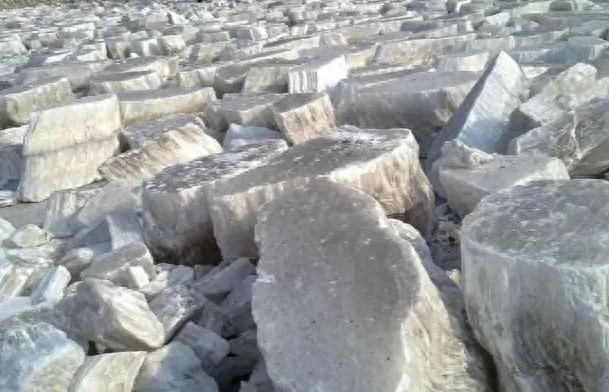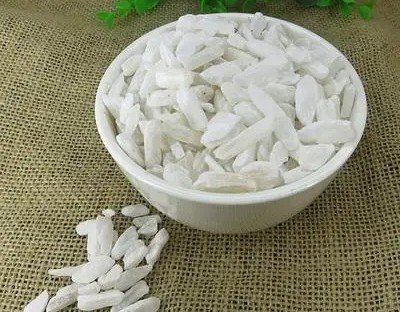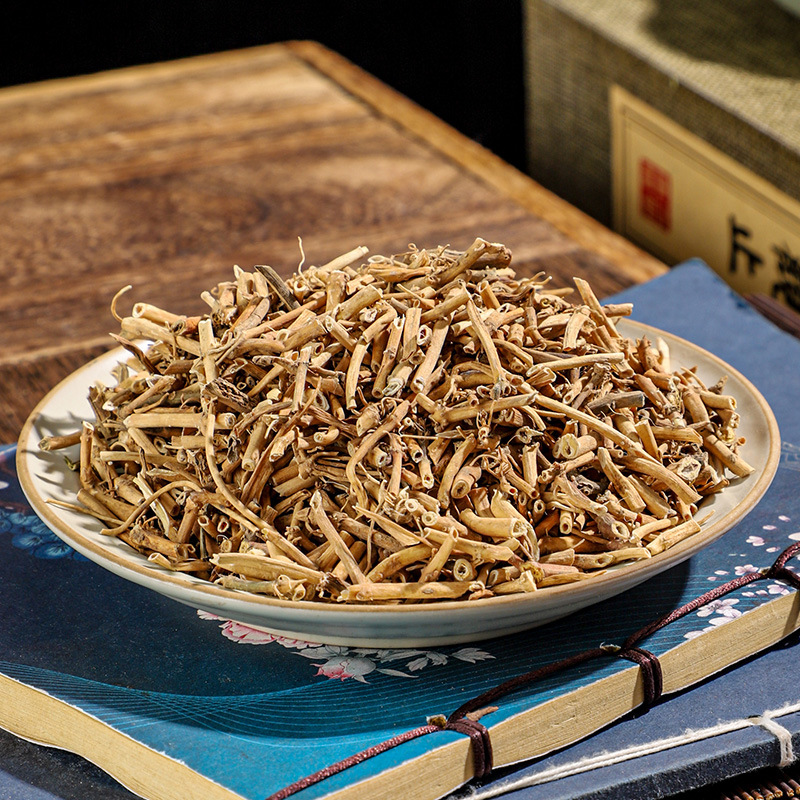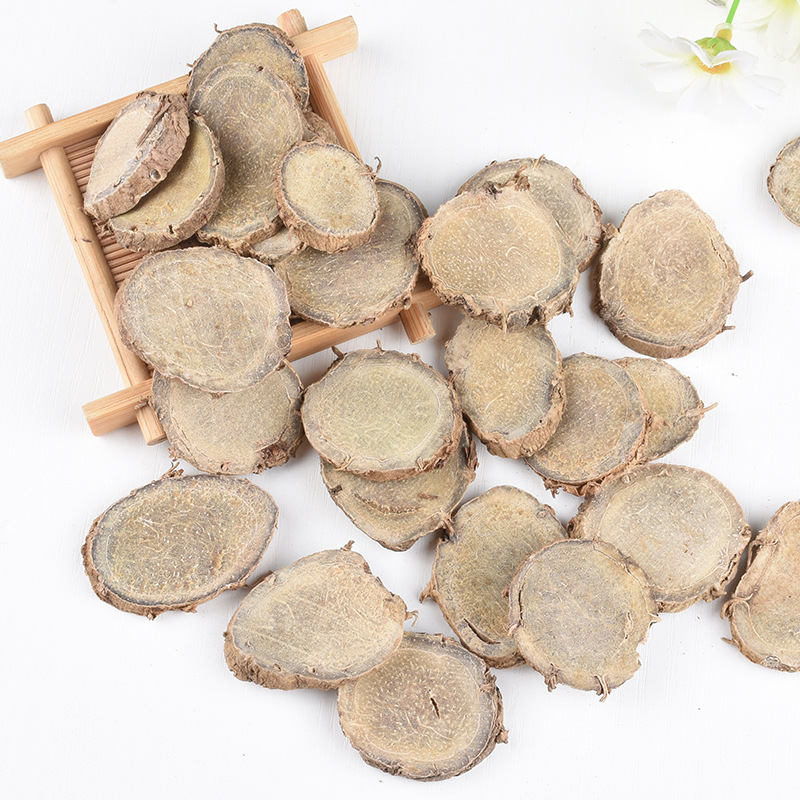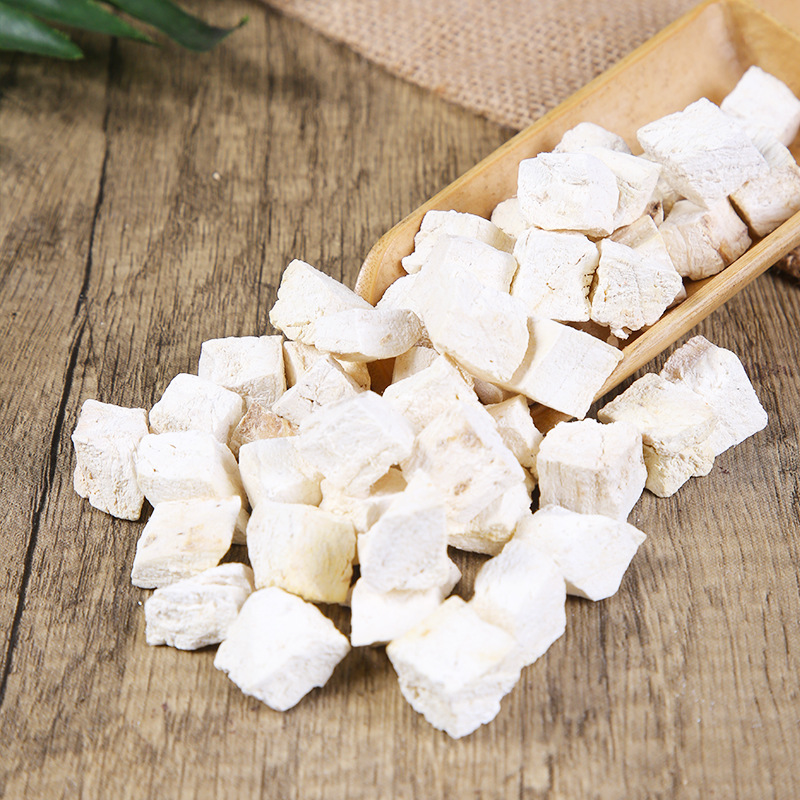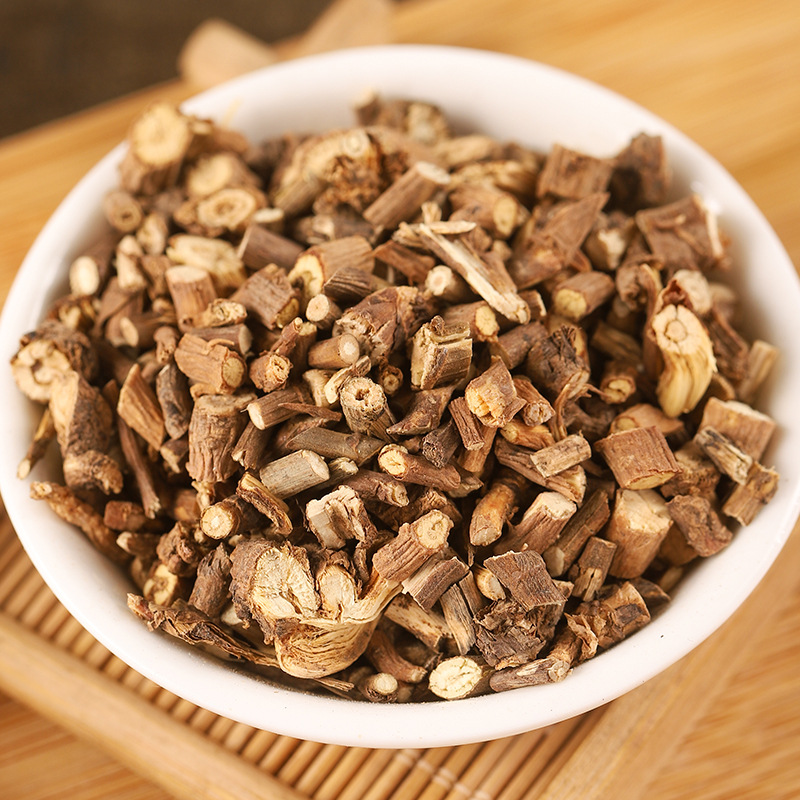
Gypsum is a mineral composed of hydrated calcium sulfate. It is distributed throughout the country, with the best quality produced in Hubei and Anhui. After excavation, impurities are removed, and it is crushed for medicinal use. It is often used raw or calcined.
Ancient texts sometimes refer to gypsum as cold water stone, which is not the same as the cold water stone used in traditional Chinese medicine today. Cold water stone is a crystal of the sulfate mineral mirabilite, with the effects of clearing heat, reducing fire, promoting orifices, and reducing swelling. Li Shizhen said, "The cold water stone used in ancient formulas is congealed water stone, while the cold water stone used in Tang and Song formulas is gypsum. Congealed water stone is formed over many years from salt essence seeping into the soil."
I. Efficacy and Application
Gypsum is pungent and sweet in flavor, and extremely cold in nature. It acts on the lung and stomach meridians.
Efficacy: Clears heat and purges fire, eliminates irritability and quenches thirst. Its characteristic is to effectively clear internal heat, suppress and subdue upward counterflow, making it a key herb for clearing heat from the Yangming meridian; one of the "Four Pillars" in traditional Chinese medicine.
It is commonly used for the treatment of external contraction of heat diseases, high fever with irritability and thirst, lung heat with wheezing and cough, exuberant stomach fire, headache, toothache, and other syndromes. Calcined gypsum is often used externally, with the effects of promoting wound healing, generating flesh, drying dampness, and stopping bleeding.
Among many physicians, Zhang Xichun had the most extensive experience in using gypsum, making him a unique figure throughout history. In his works, he shared a large number of clinical cases involving the application of gypsum, providing us with valuable materials. Due to Zhang Xichun's expertise in using yin-nourishing herbs such as gypsum and Chinese yam in clinical practice, some modern physicians have also referred to him as a representative of the "Water Immortal School." This school stands in contrast to the "Fire God School," which is prevalent in contemporary traditional Chinese medicine, forming a complementary and mutually reinforcing relationship. His medical status is self-evident.
Summary of Famous Works by Renowned Authors:
The Classic of the Materia Medica: "It primarily treats wind stroke with cold and heat, counterflow qi below the heart, fright and panting, dry mouth and parched tongue, and inability to rest."
Bie Lu: "It eliminates seasonal qi headache and body heat, triple burner great heat, skin heat, resolves flesh and promotes sweating, stops thirst, eliminates vexation and counterflow, sudden qi panting and rapid breathing, and throat heat."
Compendium of Materia Medica: "It alleviates headaches along the Yangming meridian, fever with chills, afternoon tidal fever, extreme thirst with a desire to drink, heatstroke with tidal fever, and toothache."
Changsha Materia Medica: "Gypsum, with its pungent and cool nature, is most effective in clearing the heart and lungs to eliminate restlessness, and in draining stagnant heat to relieve dry thirst."
Ben Cao Bei Yao: "A medicine for the qi aspect of all channels. Cold can clear heat and reduce fire, pungent can induce sweating and release the muscles, sweet can relax the spleen and boost qi, promote fluid production and quench thirst."
"Medical Records Combining Chinese and Western Medicine": "Gypsum is cool and dispersing, with the power to penetrate the surface and relieve muscles. For external afflictions with substantial heat, using it boldly is truly superior to golden elixirs. The 'Shennong's Classic of Materia Medica' states that it is slightly cold, indicating that its nature is not extremely cold; moreover, it mentions its suitability for postpartum lactation, which further demonstrates its excellent properties."
II. Compatibility and Application
1. For warm disease with pathogenic factors in the qi aspect, presenting symptoms such as high fever, excessive thirst, and a surging pulse, indicating excessive heat syndrome. Gypsum has a strong effect in clearing heat and purging fire, and is often used in combination with Anemarrhena asphodeloides. To treat excessive heat in the Yangming qi aspect, characterized by high fever with a flushed face, excessive thirst with a desire to drink, sweating with aversion to heat, and a surging pulse, it is often combined with Anemarrhena asphodeloides, licorice, and polished round-grained rice, as seen in the famous formula White Tiger Decoction from the Treatise on Cold Damage Diseases.
If treating exuberant heat in the qi aspect with damage to both fluids and qi, one can add a single herb, ginseng, to White Tiger Decoction, resulting in White Tiger Decoction with Ginseng.
Zhang Xichun used Baihu Jia Renshen Decoction to treat postpartum and debilitated warm diseases. To prevent the formula from being excessively cold and causing diarrhea, he often replaced japonica rice with raw Chinese yam and anemarrhena with scrophularia in the prescription, which is indeed an excellent method worth learning. At the same time, Zhang also used gypsum as the main ingredient to create four formulas: Qingjie Decoction, Liangjie Decoction, Hanjie Decoction, and Hejie Decoction. These formulas were designed according to the characteristics of different stages of warm diseases, demonstrating clear thinking and serving as a model for others.
If treating the gradual deepening of pathogenic factors, with intense heat and toxicity in the lung and stomach, blazing heat in both qi and blood, persistent high fever, and the appearance of macules and rashes, it is often combined with buffalo horn (or Li Ke's four-ingredient rhinoceros horn), moutan bark, and scrophularia root, among other heat-clearing and blood-cooling herbs, to jointly achieve the effects of detoxifying and resolving macules, clearing both qi and blood, as seen in Qingwen Baidu Decoction.
2. For cough with thick sputum, fever, and asthma caused by lung heat. Gypsum has a strong effect in clearing lung heat. For treating cough due to lung heat, thick sputum, fever, and other symptoms, it is often combined with licorice, bamboo sap, and other herbs.
If treating unresolved external heat with lung heat causing cough and wheezing, it is often combined with Ephedra and Apricot Kernel to jointly achieve the effects of clearing and dispersing lung heat and calming wheezing, as seen in the Ma Xing Shi Gan Decoction.
3. For headache and swollen and painful gums caused by stomach fire. Gypsum can purge stomach fire and treat toothache due to excess fire. It is often combined with Shengma and Xixin, taking the meaning of "releasing the constrained fire."
If treating stomach heat and yin deficiency, symptoms such as vexing heat and dry thirst, it is often combined with Shengdi, Zhimu, Niuxi, and other stomach-clearing and yin-nourishing ingredients, known as Yunu Jian.
4. Used for sores and ulcers that do not heal, eczema, burns and scalds, etc. Calcined gypsum powder has the effects of clearing heat and promoting astringency when applied externally. It can be used alone or in combination with drugs such as indigo naturalis and phellodendron bark.
III. Usage and Dosage
Gypsum is often used in decoctions, rarely in pills or powders, and can also be applied externally. The typical dosage in decoctions ranges from a few grams to several tens of grams, and it should be crushed and decocted first. For oral use, it is best used in its raw form; for external application, it must be calcined and ground into powder.
Zhang Xichun used gypsum countless times in his life, and his experience is most worthy of reference. The summary includes the following five points: First, in terms of understanding, he respected the "Shennong's Classic of Materia Medica" and believed that gypsum is slightly cold rather than extremely cold, so it can be used boldly in clinical practice. Second, for treating heat syndromes, it must be used raw when taken orally, and calcined gypsum should never be used. Third, for those with excessive real heat, it should be used in large doses. Fourth, for safety and flexibility, after decocting the medicine, it should be taken in small amounts and frequently to prevent the medicinal effects from directly reaching the lower energizer and causing diarrhea. Fifth, stop the treatment once the condition improves; there is no need to finish the entire dose once the fever subsides.
Zhang Xichun said, "The substance of gypsum is very heavy, and seven or eight qian is only a large handful. Using a large handful of slightly cold medicine to extinguish the blazing heat of cold and warmth, how can it have a great effect? Therefore, when I use raw gypsum to treat external pathogenic excess heat, even for mild cases, I must use at least two liang; if the excess heat is intense, I often use four or five liang, or seven or eight liang, either alone or in combination with other medicines. I always decoct it into three or four cups of soup, divided into four or five doses, and drink it slowly and warmly. Once the fever subsides, there is no need to finish the entire dose. The reason for decocting it in large quantities and taking it slowly is to avoid the patient's suspicion and fear, and to ensure that the medicinal effect remains in the upper and middle jiao, preventing the cold and cool nature from descending and causing diarrhea. In fact, using raw gypsum to treat external pathogenic excess heat will certainly not harm the patient, and using it boldly will certainly reduce fever. Only in cases of excess heat with deficient pulse, where the patient has both excess heat and deficient heat, following the principle of Baihu Jia Renshen Tang, using ginseng to assist gypsum will also certainly reduce fever."
IV. Application Precautions
Gypsum is cold in nature and can easily damage yang qi, so it should not be taken by those with deficiency-cold of the spleen and stomach or yin deficiency with internal heat.
According to Zhang Xichun's experience, raw gypsum should be used for internal administration, and it must be clearly indicated in the prescription, dispensing, and decoction processes.
Zhang Xichun said, "Many doctors mistakenly believe that gypsum is extremely cold and thus use it after calcination, which transforms its dispersing nature into astringency. When treating external afflictions with substantial heat, this can cause phlegm-fire to become trapped and congeal, failing to disperse. Using as little as one liang can be harmful enough to injure a person, turning a golden elixir into a deadly poison. When mishaps occur due to the misuse of calcined gypsum, conventional wisdom fails to recognize that the fault lies in the calcination, not in the gypsum itself. Instead, it is said that calcined gypsum is still dangerously potent enough to harm people, let alone uncalcined gypsum. Thus, with one voice echoing another, the use of gypsum has come to be regarded as a perilous path."
Huang Yuanyu said, "It is extremely cold to the spleen and stomach, and those with yang deficiency in the middle burner should not take it."
Wang Ang said: "If used in small amounts, it is difficult to see results. However, it can chill the stomach, and is contraindicated for those with weak stomach, blood deficiency, and those whose illness has not yet entered the Yangming stage."
Practical Notes on Traditional Chinese Medicine: 2020.11.12